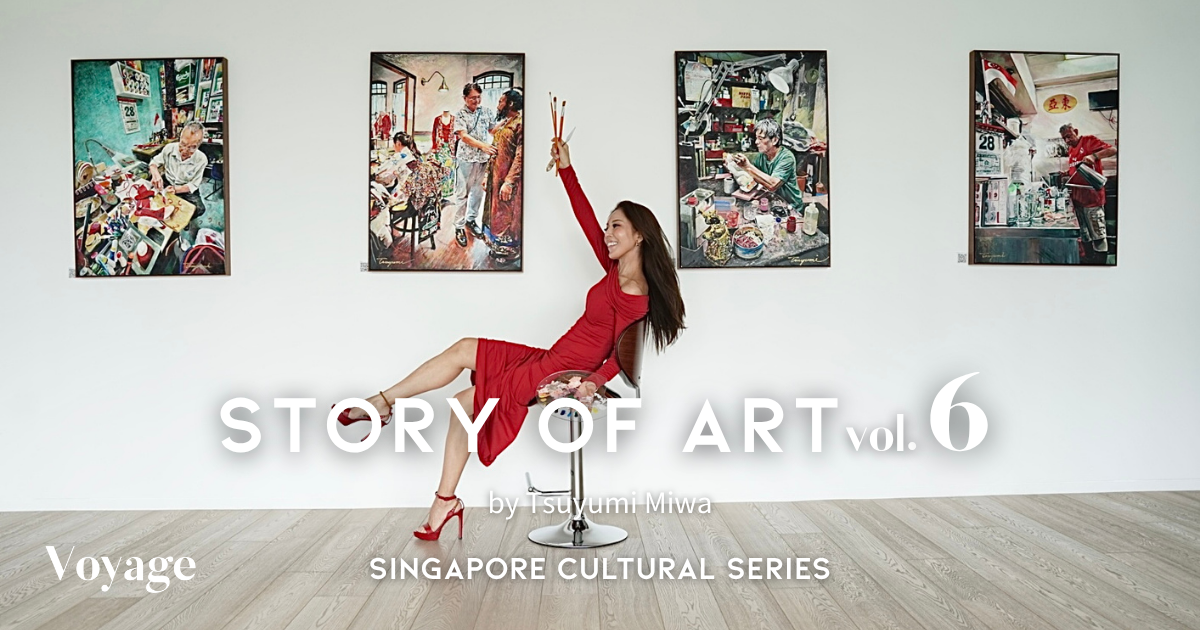
Art has always walked alongside the life of Tsuyumi Miwa—from her early years immersed in calligraphy and painting, to her time gracing the screen as an actress and delivering words as a broadcaster. Today, she continues this lifelong dialogue with creativity through her work as a visual artist.
Having lived in Japan, Italy, Australia, and now Singapore—her current base—Tsuyumi’s experiences across cultures have shaped a distinct artistic lens. With brush in hand once again, she explores the intersection of personal memory and the collective memory of Singapore, a land where diverse ethnicities and cultures coexist in vibrant harmony.
In this new column series, Story of Art, we begin by diving into Tsuyumi Miwa’s recent body of work, the Singapore Cultural Series. This ongoing series shines a spotlight on the unsung everyday heroes who form the backbone of Singapore’s multicultural society.
Let us begin by unraveling the story behind the painting that initiated this journey.
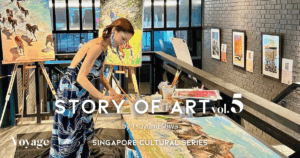
【Story of Art.5】Traditional Chinese Puppeteer – The Art of Storytelling in Motion
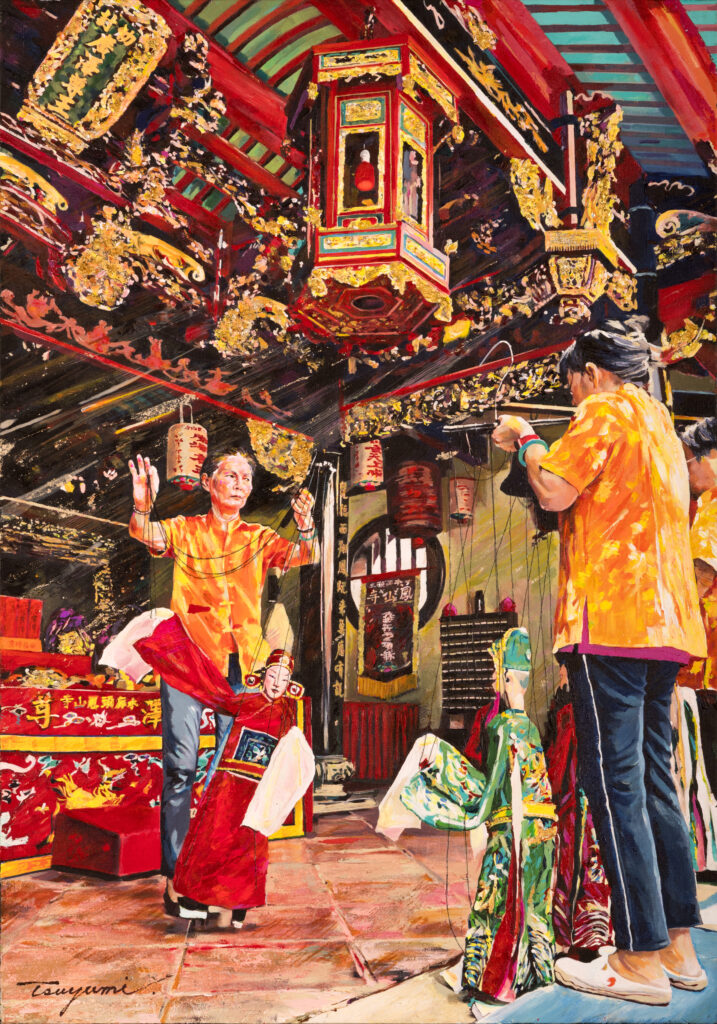
at Hong San See Temple”
“A puppet is more than wood and cloth—it is a storyteller, a vessel of culture, and a bridge between past and present, bringing legends to life with every movement.”
In Singapore’s temples, small stages once echoed with the voices of puppeteers hidden behind bright backdrops. Their art—ka-lé-hì 傀儡戲(嘉禮戲)—still lives on through dedicated performers who turn cloth and wood into storytellers of history and emotion.
A Centuries-Old Tradition Born in Fujian
Traditional Hokkien puppetry, known as ka-lé-hì 傀儡戲(嘉禮戲), originated in China’s Fujian province in the 17th century. Over the centuries, it has flourished among Hokkien-speaking communities across Singapore, Taiwan, and Malaysia, blending storytelling, music, and improvisation into a deeply expressive art form.
The Unseen Storytellers Behind the Curtain
Performed on intimate temple stages, ka-lé-hì 傀儡戲(嘉禮戲)puppeteers stay hidden behind a small backdrop, skillfully manipulating cloth puppets to enact myths, folklore, and historical dramas.
Each performance is a delicate balance between precise technique and emotional storytelling—where gods, spirits, and heroes come to life through movement and voice.
Unlike Chinese opera, ka-lé-hì 傀儡戲(嘉禮戲)relies on narration and dialogue to animate the story, inviting audiences into a world where good and evil meet, and moral lessons unfold through art.
Keeping the Art Alive in Modern Singapore – Doreen and the Spirit of Ge Yi
Though modern entertainment has transformed cultural landscapes, passionate puppeteers in Singapore continue to safeguard this ancient art.
With every flick of the wrist, old legends awaken once more—each show becoming a living archive of Hokkien heritage.
Among those preserving this tradition is Doreen, the leader of Ge Yi troupe.
Her devotion to potehi is captured in a painting that portrays her and her puppeteers in motion—hands gracefully guiding the puppets, eyes focused on every subtle gesture.
Through her performances, Doreen doesn’t merely retell ancient stories; she keeps them alive for future generations, ensuring that this art form continues to inspire wonder, nostalgia, and cultural pride.
Every potehi performance is more than entertainment—it is a dialogue across time.
In each movement, the puppeteer reconnects us with history, transforming silent cloth figures into storytellers that still whisper the wisdom of centuries.
Through the Singapore Cultural Series, Tsuyumi Miwa invites us to witness these living memories—moments where artistry, faith, and humanity intertwine in the heart of tradition.
🌕 Next Chapter
This column, Story of Art, is updated on every full moon.
The next story will be published on December 5, 2025 (Friday)—featuring another unsung hero whose everyday life illuminates the cultural soul of Singapore.