Surrounded by calligraphy and painting in her childhood, later stepping onto the screen as an actress and delivering words as an announcer—
Art has always been a quiet companion in the life of Tsuyumi Miwa.
Japan, Italy, Australia, and now Singapore, where she is currently based.
Having lived among diverse cultures, she has once again picked up her brush as an artist. Through light and color, she depicts scenes where personal memories intersect with the collective memories of Singapore, a land shaped by many cultures and ethnicities.
In this ongoing “Story of Art” series for Voyage, we turn our attention to her recent body of work, the “Singapore Cultural Series,” which honors the countless “everyday heroes” who sustain the city’s multicultural identity.
Let us trace her artistic journey and the thoughts woven into each of her works.
【Story of Art.11】 Cheongsam Maker — Timeless Elegance in Every Stitch
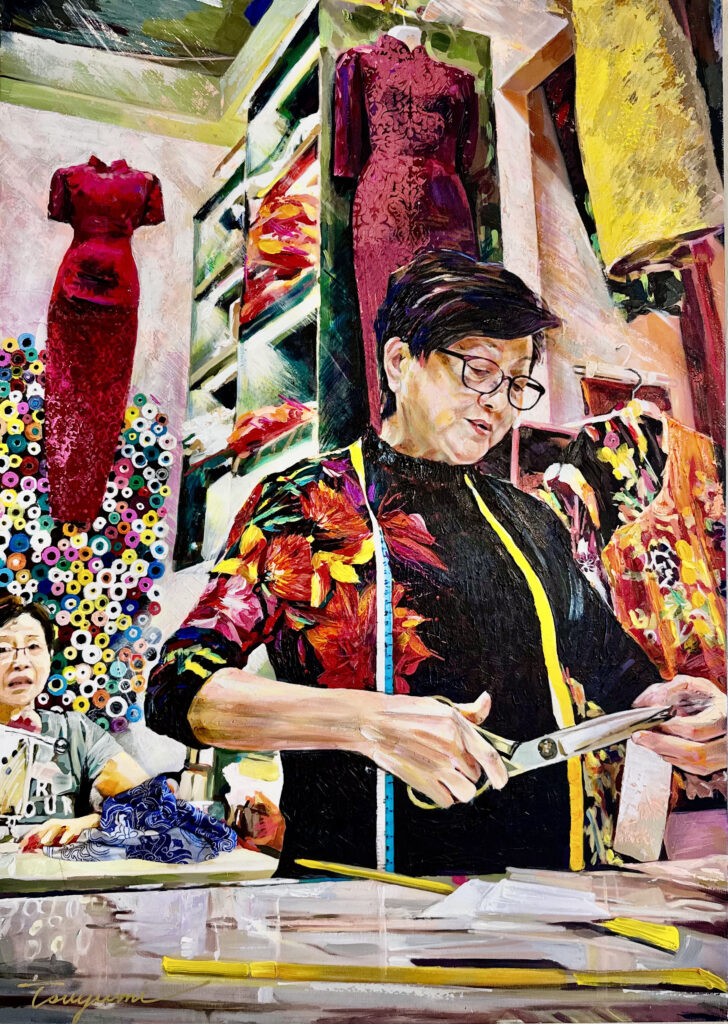
“A Cheongsam is not just a dress—it is confidence, grace, and heritage woven into every seam. To wear one is to embody history, to craft one is to preserve an art form.”
The Cheongsam, also known as qipao, stands as one of the most iconic symbols of Chinese high fashion. Originating in early 20th-century Shanghai, it evolved from the traditional Manchu qizhuang attire and rose to prominence among Chinese socialites in the 1920s and 1930s. With its signature high mandarin collar, asymmetrical closure, and form-fitting silhouette, the Cheongsam has endured as a timeless expression of elegance.
Traditionally crafted from silk, Cheongsams are often adorned with intricate embroidery and auspicious motifs such as floral patterns, phoenixes, and dragons—each symbolising femininity, strength, and grace. While the classic design remains deeply respected, contemporary interpretations continue to emerge, as modern designers reinterpret heritage through a more current lens.
A defining moment in the global revival of the Cheongsam came at the 2010 Cannes Film Festival, when actress Fan Bingbing appeared in a striking golden yellow Cheongsam embellished with dragon and cloud motifs. Her appearance captivated audiences worldwide, reigniting international admiration for this refined garment.
In Singapore, the tradition of Cheongsam-making continues through dedicated artisans such as Susan, the owner of Susan’s Batik House. Having spent decades honing her craft, she works with quiet precision and unwavering focus. Each movement of her hands reflects the confidence of experience, and every seam speaks to her deep understanding of the form.
Warm and deeply passionate about her work, Susan views each Cheongsam not simply as clothing, but as a living piece of history. Through her craftsmanship, tradition is not preserved in theory, but in practice—one garment at a time.
Every stitch carries a story of heritage, technique, and beauty. And through her continued dedication, the art of Cheongsam-making lives on, expressed in each carefully crafted piece that bridges past and present.
🌕 Next Chapter
This series is updated on every full moon.
The next article is scheduled for Saturday, May 2, 2026.