Surrounded by calligraphy and painting in her childhood, later stepping onto the screen as an actress and delivering words as an announcer—
Art has always been a quiet companion in the life of Tsuyumi Miwa.
Japan, Italy, Australia, and now Singapore, where she is currently based.
Having lived among diverse cultures, she has once again picked up her brush as an artist. Through light and color, she depicts scenes where personal memories intersect with the collective memories of Singapore, a land shaped by many cultures and ethnicities.
In this ongoing “Story of Art” series for Voyage, we turn our attention to her recent body of work, the “Singapore Cultural Series,” which honors the countless “everyday heroes” who sustain the city’s multicultural identity.
Let us trace her artistic journey and the thoughts woven into each of her works.
【Story of Art.12】Chinese Cultural Shop — A Treasure Trove of Tradition
“A culture’s heart beats in the hands of its artisans, in the tools they use, and in the treasures they preserve.”
A Chinese cultural shop is not merely a place where goods are sold.
It is a space where the memory of tradition continues to breathe.
Established in 1935, Eng Tiang Huat is a family-run Chinese cultural shop that has played a vital role in preserving Chinese heritage in Singapore. Lined along its shelves are handcrafted musical instruments, opera props, and silk tapestries—each piece reflecting a rich history. Within them lies an accumulation of aesthetic sensibilities and craftsmanship passed down through generations.
Yet the role of this shop extends far beyond retail. It has supported traditional Chinese puppetry, adapting it for modern audiences while safeguarding its essence. Deeply rooted in folklore and history, puppetry remains an essential form of expression in cultural celebrations. Rather than simply preserving tradition, the shop has ensured that it continues to live and evolve.
The current owner, Jeffrey Eng, grew up in a historic shophouse in Geylang, where his family has lived for generations. The shop feels like a living museum. Antiques and artefacts fill the space, including a 1955 rotary telephone—restored with the help of an engineer in London. A 1937 Singer sewing machine and other relics quietly connect past generations to the present.
“In those days, putting your name on your shop was a sign of honesty,” Jeffrey reflects.
His grandfather began as a tailor before expanding into traditional Chinese goods. Over time, the shop evolved into what can only be described as a cultural treasure trove—a place not only for commerce, but for the continuation of craftsmanship and aesthetic values. A lineage of handwork, carefully preserved.
Jeffrey often jokes that he was “born in the shop, grew up in the shop, and married in the shop.” It is likely that his life will continue to unfold here.
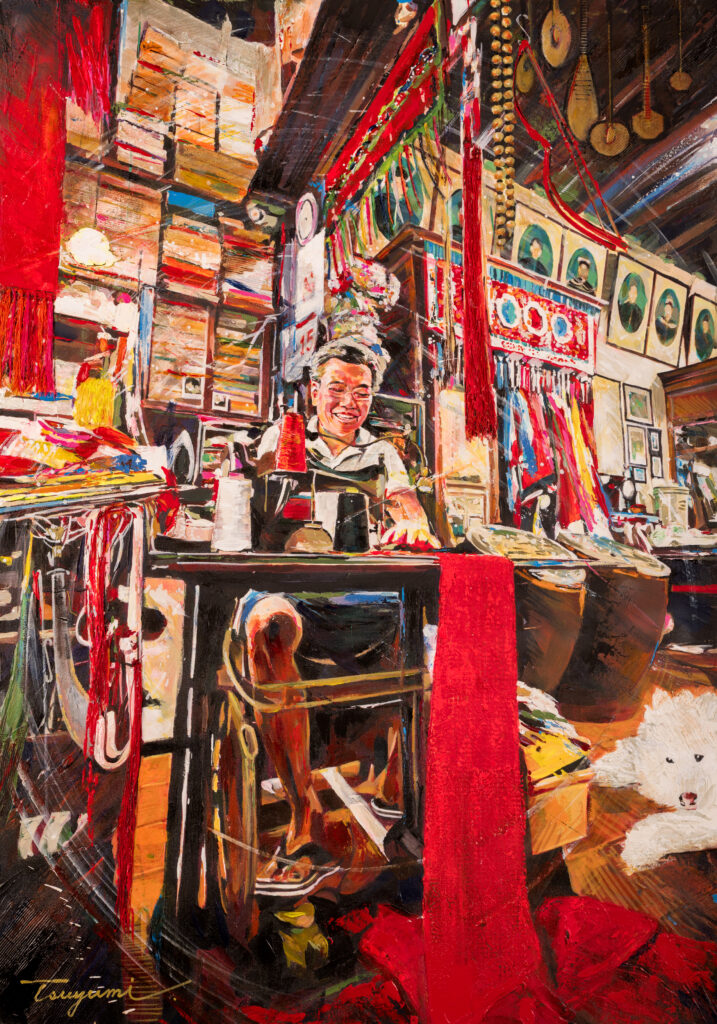
In my painting, he is depicted crafting banners for Chinese opera performances using fine silk imported from China. What emerges in that image is a sense of dedication and pride—qualities that have sustained Eng Tiang Huat for nearly a century. A quiet yet enduring light of cultural continuity.
In the next chapter, another “everyday hero” will come into focus.
A new story of Singapore’s diverse cultural landscape, revealed through each brushstroke.
🌕 Next Chapter
This series is updated on every full moon.
The next article is scheduled for Sunday, May 31, 2026.