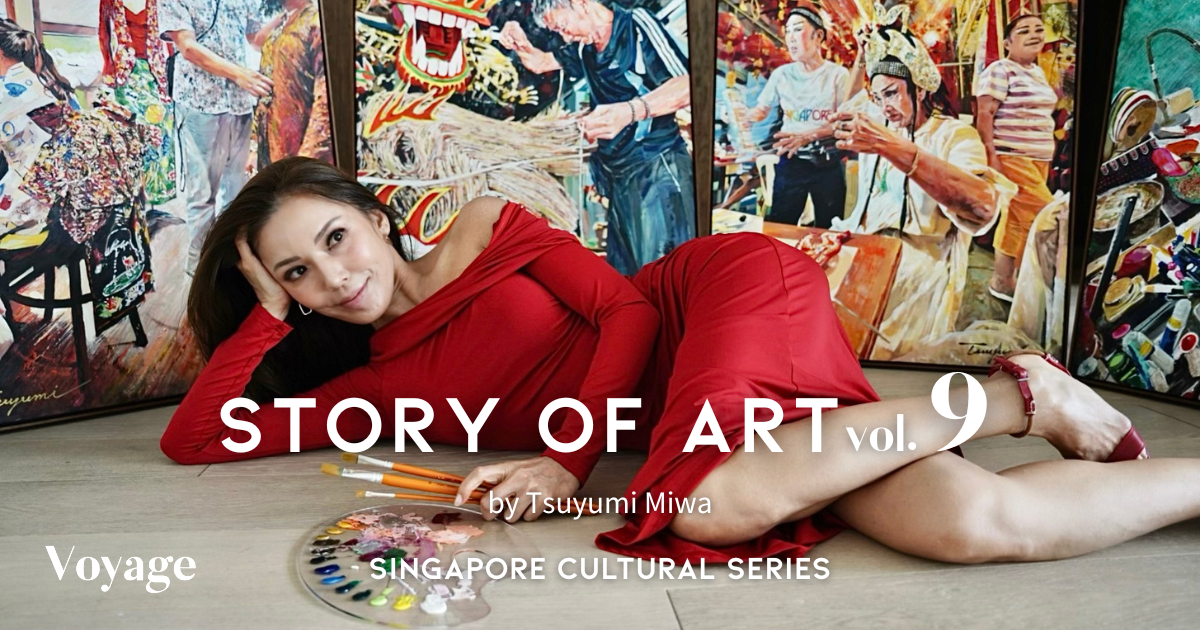
Surrounded by calligraphy and painting in her childhood, later stepping onto the screen as an actress and delivering words as an announcer—
Art has always been a quiet companion in the life of Tsuyumi Miwa.
Japan, Italy, Australia, and now Singapore, where she is currently based.
Having lived among diverse cultures, she has once again picked up her brush as an artist. Through light and color, she depicts scenes where personal memories intersect with the collective memories of Singapore, a land shaped by many cultures and ethnicities.
In this ongoing “Story of Art” series for Voyage, we turn our attention to her recent body of work, the “Singapore Cultural Series,” which honors the countless “everyday heroes” who sustain the city’s multicultural identity.
Let us trace her artistic journey and the thoughts woven into each of her works.
【Story of Art.9】Peranakan Shoe Maker – Handmade Traditional Shoes
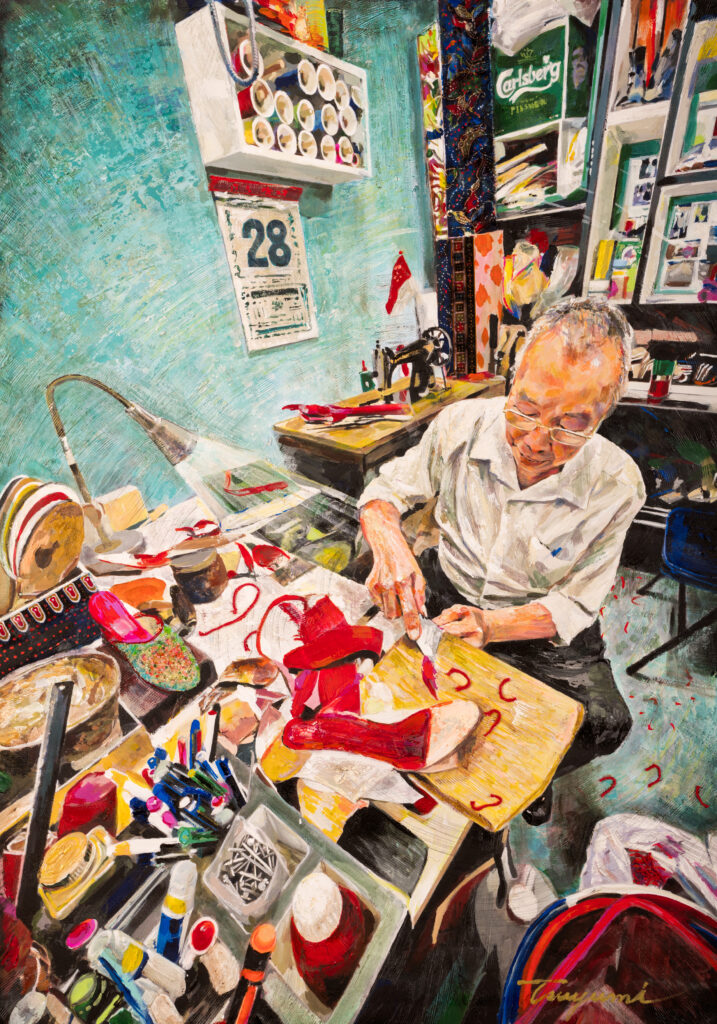
Every stitch, every bead, every thread tells a story —
of culture, craftsmanship, and the enduring beauty of Peranakan heritage.
n a quiet corner of Golden Mile Tower, an 86-year-old shoemaker continues his work in silence.
Seated at a worn workbench, carefully stitching tiny beads onto fabric, is Soong Kwek Choong, one of the last traditional shoemakers in Singapore.
He began learning the craft at the age of 13 from his father, originally as a means of making a living.
More than seventy years later, he still completes every pair entirely by hand.
Each pair takes approximately two days to finish, every stitch placed with unwavering precision — a reflection of decades of experience.
“Not everyone can do this,” he says gently.
“As long as my eyes can still see clearly and my hands are steady, I want to continue.
I am happy that I can still work.”
Mr. Soong creates Kasut Manek, traditional Peranakan beaded shoes that represent one of the finest expressions of Peranakan culture.
The Peranakan community emerged in Southeast Asia between the 15th and 17th centuries, blending Chinese and Malay traditions.
Known for its vibrant colours and intricate designs, Peranakan heritage remains deeply woven into Singapore’s cultural identity.
Floral motifs, birds, and geometric patterns are carefully rendered in beads on canvas or leather, transforming each shoe into a shimmering mosaic.
The process begins with a wooden frame called a pidangan, which holds the fabric taut while each bead is hand-sewn into place, one by one.
Historically, Peranakan women — known as Nyonyas — spent months crafting a single pair of Kasut Manek.
Their patience and skill were passed down through generations, embodying a devotion to craftsmanship that valued time as much as beauty.
In an era dominated by mass production, such meticulous handwork is becoming increasingly rare.
Yet in Mr. Soong’s shoes, time itself seems carefully preserved.
Each pair carries not only aesthetic beauty, but also the quiet memory of a culture shaped by dedication and care.
For those wishing to explore Peranakan heritage more deeply, a visit to the Peranakan Museum offers valuable insight.
Through its exhibitions, visitors can discover the history, craftsmanship, and enduring influence of Peranakan culture within Singapore’s multicultural society.
In a small workshop, the rhythm of handwork continues.
Each stitch quietly connects the past to the present — and carries Peranakan memories forward into the future.
Next time, another everyday hero will appear. Beyond each line and color, a new story of Singapore’s many cultures awaits.
🌕 Next Chapter
This series is updated on every full moon.
The next article is scheduled for Tuesday, March 3, 2026.